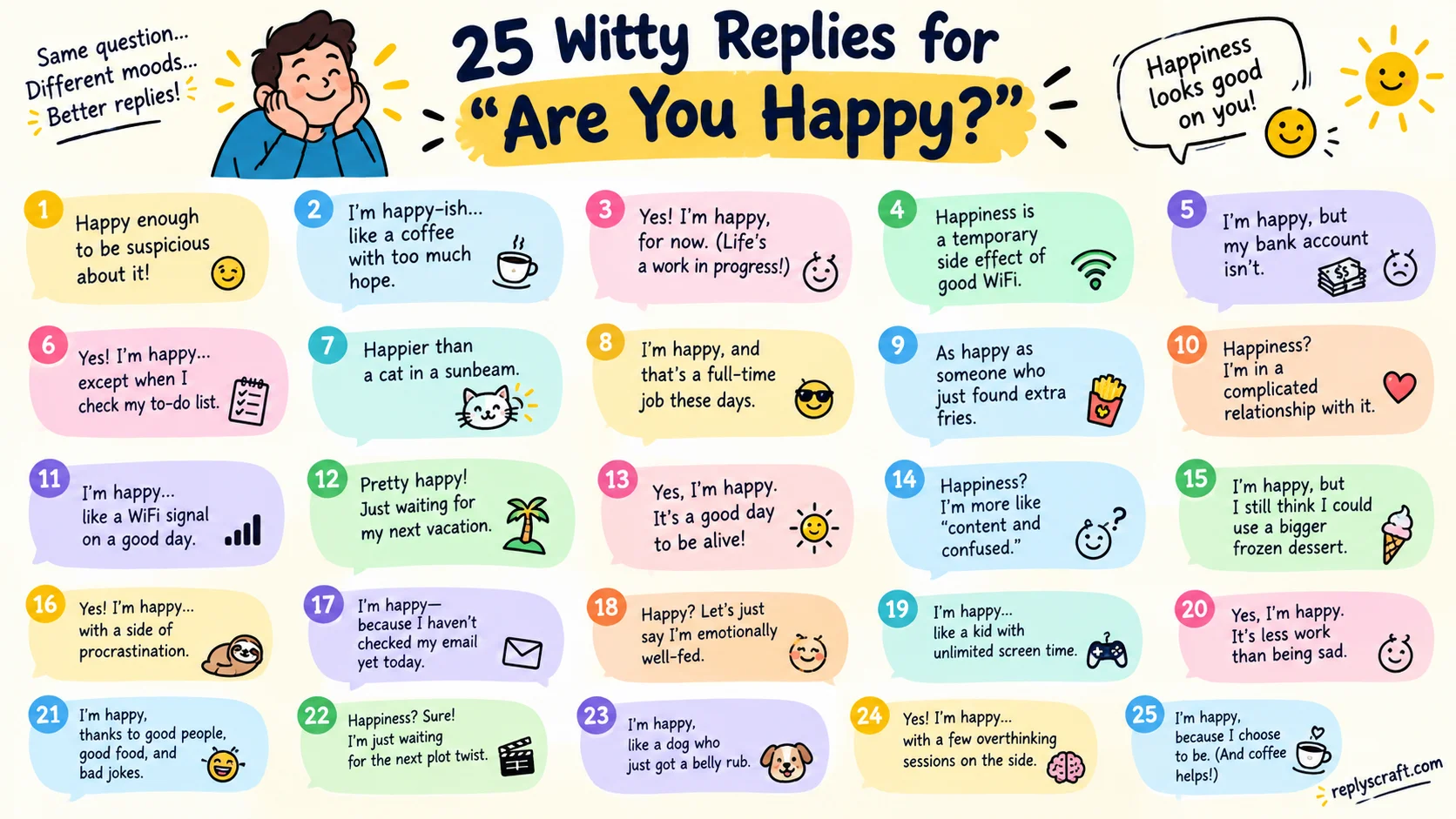

Replies for “Are You Happy?” can help you answer with confidence when someone asks about your feelings. Your mood, relationship, and the person asking all matter. You can choose a funny, sweet, honest, or flirty response depending on the situation and how openly you want to share.
When someone asks this simple question, your answer can have different meanings. You might be happy and say life feels good, or admit things are complicated. A short response works for casual moments, while a thoughtful answer suits deeper conversations. Always choose words that honestly express your current emotional state.
The person asking can also change the tone. A friend, crush, partner, or coworker may want different answers. Try a funny comeback when you want to keep things light, or a flirty response when the moment feels romantic. A clever answer can make the conversation feel natural, personal, and memorable.
Funny Replies for “Are You Happy?”
When the question comes from someone you know well, a humorous answer can turn an ordinary exchange into a fun conversation. These replies work best when the other person already understands your sense of humor.
Meaning
These Replies communicate that you are taking the question lightly while showing some personality. They are especially useful when you are actually in a decent mood but do not want to give a boring one-word answer.
Tone
Funny, casual, playful.
Example
Friend: Are you happy?
You: Define happy. Does having snacks count?
Best Use
Use these with friends, siblings, or people who are comfortable joking with you.
1. “I’m happy enough to avoid filing a complaint.”
Meaning
You are saying that things are going reasonably well, but with a deliberately dramatic twist.
Tone
Funny, sarcastic, casual.
Example
Friend: Are you happy these days?
You: I’m happy enough to avoid filing a complaint.
Best Use
Great for casual texting and conversations with friends.
2. “Absolutely. My problems just haven’t received the memo yet.”
Meaning
You are joking that you feel happy even though life still has its usual problems.
Tone
Clever, humorous, confident.
Example
Friend: Are you happy?
You: Absolutely. My problems just haven’t received the memo yet.
Best Use
Works particularly well when you want humor without sounding negative.
3. “I’m on a free trial of happiness.”
Meaning
You are joking that happiness feels temporary or limited.
Tone
Witty, playful, slightly sarcastic.
Example
Friend: So, are you happy?
You: I’m on a free trial of happiness. So far, so good.
Best Use
Perfect for casual conversations and social media-style replies.
4. “Ask me after I’ve had something to eat.”
Meaning
You are playfully suggesting that your mood depends on basic necessities.
Tone
Funny, relaxed, relatable.
Example
Friend: Are you happy?
You: Ask me after I’ve had something to eat.
Best Use
Excellent for friends and lighthearted everyday conversations.
Clever Responses That Make Them Think
Sometimes you want your reply to be more interesting than simply making a joke. A clever response can answer the question while opening up a deeper conversation.
Meaning
These answers suggest that happiness is not always a simple yes-or-no question. They work when you want to sound thoughtful without becoming overly serious.
Tone
Clever, thoughtful, confident.
Example
Person: Are you happy?
You: I’m learning not to measure happiness by whether every day goes perfectly.
Best Use
Good for meaningful conversations, texting, or talking with someone who genuinely cares about you.
5. “I’m happy with where I am, even if I’m not where I want to be yet.”
Meaning
You are acknowledging that life is still a work in progress.
Tone
Mature, positive, reflective.
Example
Friend: Are you happy with life?
You: I’m happy with where I am, even if I’m not where I want to be yet.
Best Use
Useful when you want an honest answer with a positive outlook.
6. “Some days I’m happy. Some days I’m just well-rested.”
Meaning
This humorous observation separates genuine happiness from simply having a good day.
Tone
Witty, relatable, casual.
Example
Friend: You seem happy today. Are you?
You: Some days I’m happy. Some days I’m just well-rested.
Best Use
Great for friends and casual conversations.
Short Replies for Texting
Text conversations often move quickly, so a short reply can have more impact than a long explanation. These are useful when someone sends you a simple “Are you happy?” message and you want to respond without overthinking it.
Meaning
Short replies communicate your mood quickly while leaving room for the other person to continue the conversation.
Tone
Casual, confident, playful.
Example
Them: Are you happy?
You: Happier than yesterday. 😌
Best Use
Best for texting, DMs, and quick conversations.
7. “Depends who’s asking. 😉”
Meaning
The answer intentionally leaves some mystery and invites the other person to respond.
Tone
Playful, teasing, slightly flirty.
Example
Them: Are you happy?
You: Depends who’s asking. 😉
Best Use
Works best when there is already a playful relationship. Avoid it if the situation is strictly professional.
8. “Currently accepting happiness.”
Meaning
You are jokingly presenting happiness as something you are still looking for.
Tone
Short, witty, humorous.
Example
Friend: Are you happy?
You: Currently accepting happiness.
Best Use
Good for casual texting and funny conversations.
9. “Pretty much. No refunds.”
Meaning
You are confidently saying yes while turning the answer into a joke.
Tone
Funny, confident, playful.
Example
Them: Are you happy?
You: Pretty much. No refunds.
Best Use
Works nicely in relaxed conversations with friends.
Confident Answers When You Mean “Yes”
Sometimes the best comeback is not a joke. If you genuinely feel happy, you can answer confidently without sounding overly dramatic.
Meaning
These replies communicate contentment and self-confidence without pretending that everything in life is perfect.
Tone
Confident, positive, sincere.
Example
Person: Are you happy?
You: Yes. I’ve learned that I don’t need everything to be perfect to appreciate what I have.
Best Use
Useful for personal conversations, social posts, or someone who is sincerely checking on you.
10. “Yeah. I’ve got enough reasons to smile.”
Meaning
You are saying that you have genuine reasons to appreciate your life.
Tone
Warm, positive, sincere.
Example
Friend: Honestly, are you happy?
You: Yeah. I’ve got enough reasons to smile.
Best Use
Good for friends, family, and meaningful conversations.
11. “I am. And I’m not waiting for life to become perfect first.”
Meaning
This expresses contentment without claiming that everything is easy.
Tone
Confident, mature, positive.
Example
Person: Are you happy with your life?
You: I am. And I’m not waiting for life to become perfect first.
Best Use
Best when someone is asking about your overall well-being or outlook.
Playful Replies for Someone You Like
If “Are you happy?” comes from someone you are interested in, you can make the response slightly more personal. Keep the flirtation proportional to your relationship; subtle usually works better than forcing a romantic line.
Meaning
These replies turn a simple question into an opportunity for playful chemistry.
Tone
Flirty, teasing, charming.
Example
Them: Are you happy?
You: I was doing pretty well until you started asking dangerous questions. 😉
Best Use
Use with someone you already have a comfortable, flirtatious dynamic with.
12. “I might be happier if you stayed around.”
Meaning
You are subtly suggesting that the person contributes to your happiness.
Tone
Flirty, warm, romantic.
Example
Them: Are you happy?
You: I am. I might be happier if you stayed around, though.
Best Use
Best for dating or established romantic interest—not workplace conversations.
Also Read This: 20 Best Replies to “Is Everything Okay?”
13. “I was. Then you asked, and now I’m suspicious.”
Meaning
You are teasing the person rather than giving a serious answer.
Tone
Playful, flirty, mischievous.
Example
Them: Are you happy?
You: I was. Then you asked, and now I’m suspicious.
Best Use
Good for playful texting when both people enjoy teasing.
Sarcastic Replies When Someone Is Being Nosy
Not every “Are you happy?” is asked with good intentions. If someone is being intrusive, you can answer with mild sarcasm without turning the conversation into an argument.
Meaning
These responses create a little distance while making it clear that you do not want to discuss your personal life in detail.
Tone
Sarcastic, direct, controlled.
Example
Acquaintance: Are you happy?
You: That information is currently classified.
Best Use
Useful when someone is asking personal questions you would rather not answer.
Watch the tone: Sarcasm can sound much harsher in text than it does face-to-face.
14. “Why, are you conducting a survey?”
Meaning
You are jokingly questioning why the person needs to know.
Tone
Sarcastic, witty, playful.
Example
Them: Are you happy?
You: Why, are you conducting a survey?
Best Use
Good for acquaintances or friends who are being unusually curious.
15. “That depends on what you’re planning to do with the information.”
Meaning
You are politely signaling that the question feels personal.
Tone
Clever, guarded, slightly sarcastic.
Example
Them: Are you happy these days?
You: That depends on what you’re planning to do with the information.
Best Use
Best when you want to maintain a boundary without becoming openly confrontational.
Respectful Responses When You’re Not Happy
A witty comeback is not always necessary. If someone genuinely cares about you, honesty may be the better response.
Meaning
These responses acknowledge difficult feelings while keeping the conversation manageable.
Tone
Honest, calm, respectful.
Example
Friend: Are you happy?
You: Not completely right now, but I’m trying to get myself to a better place.
Best Use
Best with trusted friends, family members, or anyone who is sincerely concerned about you.
16. “Not every day, but I’m getting there.”
Meaning
You are being honest without making the conversation unnecessarily heavy.
Tone
Honest, hopeful, calm.
Example
Friend: Are you happy?
You: Not every day, but I’m getting there.
Best Use
A strong choice when you want to acknowledge that things are difficult while remaining optimistic.
17. “I’m okay. Happiness is still a work in progress.”
Meaning
You are communicating that you are doing reasonably well but still have personal things to work through.
Tone
Reflective, honest, mature.
Example
Friend: Are you actually happy?
You: I’m okay. Happiness is still a work in progress.
Best Use
Good for deeper conversations where honesty matters more than humor.
Professional Ways to Answer “Are You Happy?”
At work, the safest response depends on who is asking and why. If a manager asks about your job satisfaction, a sarcastic comeback can easily create the wrong impression.
Meaning
Professional answers acknowledge the question without oversharing personal details or criticizing the workplace unnecessarily.
Tone
Professional, polite, composed.
Example
Manager: Are you happy with your current role?
You: Overall, yes. I’m enjoying the work, and I’m also looking for opportunities to keep developing my skills.
Best Use
Use these with managers, coworkers, clients, or professional contacts.
18. “I’m happy with the progress I’m making.”
Meaning
This gives a positive answer while focusing on growth rather than making an absolute claim about everything.
Tone
Professional, positive, confident.
Example
Coworker: Are you happy with how things are going?
You: I’m happy with the progress I’m making.
Best Use
Suitable for workplace conversations and professional networking.
19. “I’m focused on making the next step even better.”
Meaning
Instead of giving a simple emotional answer, you redirect the conversation toward goals and progress.
Tone
Professional, optimistic, forward-looking.
Example
Manager: Are you happy in your current position?
You: I’m grateful for the experience, and I’m focused on making the next step even better.
Best Use
Helpful when discussing career satisfaction or future plans.
When You Want to Turn the Question Back on Them
Sometimes the most interesting response is to answer briefly and then return the question. This keeps the conversation balanced and can reveal why they asked in the first place.
Meaning
You acknowledge their question while encouraging them to share their own feelings.
Tone
Friendly, conversational, thoughtful.
Example
Friend: Are you happy?
You: Most of the time. What about you?
Best Use
Excellent for friends, family, dating conversations, and meaningful chats.
20. “I think so. But now I’m curious—are you?”
Meaning
You give a moderate answer while inviting a more honest conversation.
Tone
Thoughtful, friendly, conversational.
Example
Them: Are you happy these days?
You: I think so. But now I’m curious—are you?
Best Use
Great when you suspect the person may actually be asking because they want to talk about themselves.
21. “I could answer that, but I’d rather hear your answer first.”
Meaning
You playfully reverse the question and encourage the other person to open up.
Tone
Clever, curious, slightly mysterious.
Example
Friend: Are you happy?
You: I could answer that, but I’d rather hear your answer first.
Best Use
Best for deeper one-on-one conversations.
One-Liners for Social Media or Casual Chats
If you need a response that works as a quick comment, status reply, or DM, keep it punchy. A short line is easier to read and usually feels more natural online.
Meaning
These one-liners communicate an attitude without requiring a full conversation.
Tone
Witty, casual, humorous.
Example
Someone: Are you happy?
You: Happier than my Wi-Fi signal, at least.
Best Use
Good for casual online conversations and comments.
22. “Happy enough to mind my own business.”
Meaning
You are jokingly suggesting that your life is going fine and you are not interested in unnecessary drama.
Tone
Confident, witty, slightly sarcastic.
Example
Them: Are you happy?
You: Happy enough to mind my own business.
Best Use
Works when you want a little attitude without being aggressively rude.
23. “I’m somewhere between peaceful and hungry.”
Meaning
You turn an emotional question into a light everyday joke.
Tone
Funny, casual, relatable.
Example
Friend: Are you happy?
You: I’m somewhere between peaceful and hungry.
Best Use
Perfect for relaxed conversations with friends.
A Comeback That Is Funny but Still Kind
If you want humor without making the other person feel dismissed, choose a response that acknowledges the question first. This is especially useful when you know they are asking because they care.
Meaning
You keep the conversation light while showing that you appreciate their concern.
Tone
Warm, playful, friendly.
Example
Friend: Are you happy?
You: I am—and I appreciate you checking. Now tell me why you’re asking. 😄
Best Use
Ideal when someone is genuinely checking in on you.
24. “I’m doing pretty well—and I like that you asked.”
Meaning
You answer positively while recognizing the other person’s concern.
Tone
Warm, sincere, friendly.
Example
Friend: Are you happy these days?
You: I’m doing pretty well—and I like that you asked.
Best Use
Good for close friends, family, and thoughtful conversations.
25. “Happy? I’ve got my moments—and I’m enjoying them.”
Meaning
This avoids pretending that happiness is constant while still giving an optimistic answer.
Tone
Relaxed, mature, positive.
Example
Person: Are you happy with life?
You: Happy? I’ve got my moments—and I’m enjoying them.
Best Use
Useful when you want something more interesting than “yes” but do not want to be sarcastic.
How to Choose the Right Comeback
The best response is not necessarily the funniest one. Think about who asked, why they asked, and what kind of conversation you want next.
If it is a close friend, a playful answer such as “I’m on a free trial of happiness” can keep things light. If someone you like asks, a subtle flirty response can create chemistry. If a coworker asks, keep your answer professional. And if someone is genuinely worried about you, an honest response is usually better than hiding behind sarcasm.
A useful rule is to match their emotional investment. A casual question deserves a casual answer; a serious question deserves at least some sincerity.
Quick Tip
If you cannot tell whether someone is joking or genuinely concerned, start with a neutral answer and see where they take the conversation.
FAQs:
What is a good reply to “Are You Happy?”
A good reply depends on your feelings and the person asking. You can be honest, funny, sweet, flirty, or thoughtful based on the situation.
How can I give a funny response to “Are You Happy?”
Try a playful answer such as, “Define happy. Does having snacks count?” This keeps the conversation light and can make the other person laugh.
What should I say if I am not happy?
You can be honest without explaining everything. A simple response like, “I’m getting there, one day at a time,” shares your feelings while keeping the answer comfortable.
How do I respond when my crush asks “Are You Happy?”
A flirty response can make the moment more interesting. You might say, “I am, especially when I get to talk to you,” if that matches your feelings.
Can “Are You Happy?” be a serious question?
Yes, it can be a serious question when someone genuinely cares about your emotional state. A thoughtful and honest answer can help create a deeper, more meaningful conversation.
Conclusion:
Replies for “Are You Happy?” can make everyday conversations easier by helping you choose a funny, honest, sweet, or flirty response that naturally fits your feelings.
Whether the moment is casual, romantic, or serious, choosing the right words can make your answer feel more natural and personal. Be honest, match the mood, and let your personality guide the response.




1 thought on “25 Witty Replies for “Are You Happy?””