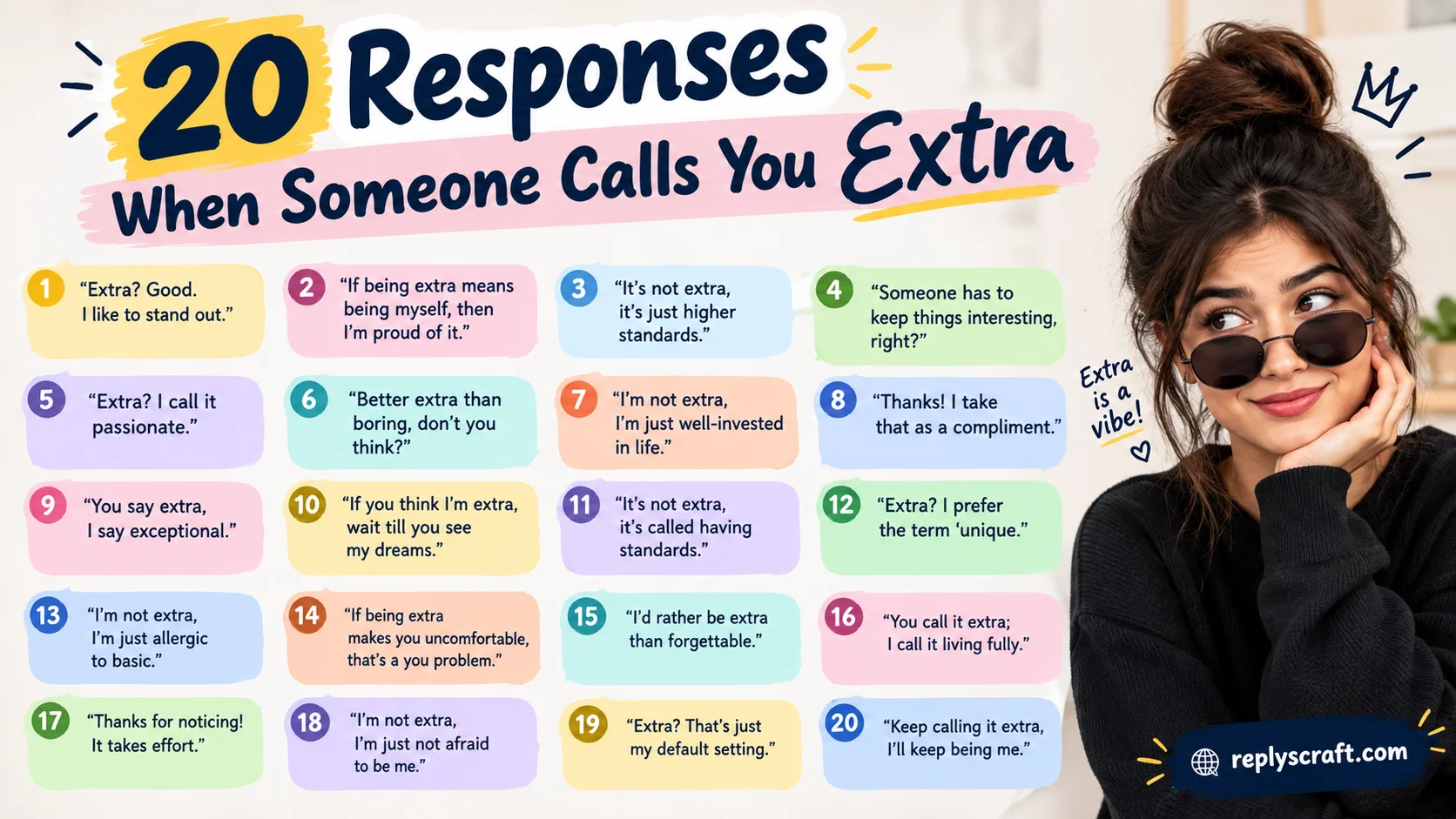

Responses When Someone Calls You Extra can help you stay confident, funny, and calm when someone calls you extra. The right reply depends on whether their comment feels playful, flirty, teasing, or critical.
Being called extra is not always negative. You might be dramatic, stylish, energetic, or simply expressive. A witty or unbothered response can keep the conversation enjoyable without creating unnecessary conflict. Choose words that match the situation and show your personality naturally.
Whether you need funny comebacks, flirty responses, savage replies, or polite answers, your response should fit the moment. You can use humor, confidence, and maturity when texting friends, coworkers, or a crush. Staying true to yourself helps you handle playful teasing without making things awkward.
Funny Things to Say When Someone Calls You Extra
If someone calls you extra while joking around, a funny response can keep the exchange light. You do not need to defend yourself seriously when the other person is clearly teasing. A little self-awareness can actually make your reply more entertaining.
The key is to sound like you are in on the joke rather than offended by it. These responses work particularly well with friends who already understand your personality.
Meaning
This response accepts the “extra” label and turns it into something funny instead of treating it as an insult.
Tone
Funny, playful, confident.
Example
Friend: Why did you decorate your room like that? You’re so extra.
You: Extra? I prefer “committed to the vibe.”
Best Use
Use it with friends, siblings, or people who are joking with you.
Meaning
This comeback suggests that being ordinary simply is not your style.
Tone
Witty, humorous, self-assured.
Example
Friend: You brought three outfits for one evening?
You: I don’t do basic. It’s a lifestyle choice.
Best Use
Great for casual conversations and text messages.
Short Replies When Someone Calls You Extra
Sometimes the conversation does not need a long comeback. A short response can sound more confident because you are not trying too hard to explain yourself.
Short replies are especially useful in texting, comments, or quick conversations where the other person makes a casual remark. Choose something that matches your personality instead of sending a paragraph to defend yourself.
Meaning
You are saying that you are perfectly comfortable with your personality.
Tone
Short, confident, casual.
Example
Person: You’re so extra.
You: And I’m okay with that.
Best Use
Use it when you want to acknowledge the comment without turning it into a debate.
Meaning
This response turns “extra” into a positive quality.
Tone
Confident, light, direct.
Example
Person: Why do you always do the most?
You: Because doing the least isn’t my thing.
Best Use
Good for texting, social media replies, and casual conversations.
Clever Comebacks for Being Called Extra
A clever comeback does not have to be insulting. The strongest ones often take the other person’s wording and give it a completely different meaning.
These responses are useful when you want to sound quick-witted without becoming unnecessarily rude. They work best when the conversation already has a playful or teasing atmosphere.
Meaning
You are suggesting that your enthusiasm is something to appreciate rather than criticize.
Tone
Clever, confident, playful.
Example
Friend: You’re extra for planning the whole weekend already.
You: Someone has to make the memories worth remembering.
Best Use
Best among friends or in relaxed social situations.
Meaning
This response lightly points out that being “extra” can simply mean putting effort into things.
Tone
Witty, mature, confident.
Example
Person: You really went all out for this?
You: If I’m going to do it, I might as well do it properly.
Best Use
Useful when someone is questioning why you put so much effort into something.
Confident Responses to “You’re Extra”
When someone uses “extra” as criticism, confidence can be more effective than sarcasm. You do not have to prove that your behavior is normal. You can simply show that you are comfortable with it.
A confident response works particularly well when the other person is trying to make you feel embarrassed about your personality, clothing, enthusiasm, or choices.
Meaning
You are making it clear that their opinion does not control how you express yourself.
Tone
Confident, calm, self-assured.
Example
Person: You’re honestly too extra.
You: Maybe. But I’m comfortable being myself.
Best Use
Use it when you want to stand your ground without starting an argument.
Meaning
This response communicates that being different does not automatically make your behavior wrong.
Tone
Direct, confident, mature.
Example
Person: Why can’t you just be normal?
You: Because normal isn’t really my goal.
Best Use
Good for casual conversations where someone is criticizing your personality.
Playful Replies to “You’re So Extra”
If the person is teasing you affectionately, match their energy instead of becoming defensive. A playful answer can turn the comment into an inside joke.
This approach is especially useful when “extra” means dramatic, energetic, stylish, expressive, or enthusiastic rather than genuinely problematic.
Meaning
You are jokingly admitting that the accusation is probably true.
Tone
Playful, cheerful, teasing.
Example
Friend: You’re extra for bringing a whole camera to dinner.
You: Somebody has to document your questionable decisions.
Best Use
Great for close friends and group chats.
Meaning
You are exaggerating the situation for comedic effect.
Tone
Lighthearted, dramatic, funny.
Example
Friend: You made a playlist for the road trip?
You: Obviously. This is not a road trip. It’s an experience.
Best Use
Perfect for friends, texting, and casual social situations.
Sarcastic Comebacks for Someone Calling You Extra
Sarcasm can be funny, but it needs the right audience. Over text, sarcasm can sometimes sound harsher than intended because the other person cannot hear your voice or see your expression.
Use these when you know the person understands your humor. Avoid them when speaking to a manager, client, stranger, or someone who already seems irritated.
Meaning
You are sarcastically suggesting that their criticism is not going to change you.
Tone
Sarcastic, confident, slightly sharp.
Example
Person: You’re being extra again.
You: Thank you for noticing. I was starting to worry I was being too subtle.
Best Use
Works best with friends or people who enjoy sarcastic humor.
Meaning
This reply deliberately exaggerates their criticism to make it funny.
Tone
Dry, sarcastic, playful.
Example
Friend: You really didn’t need to make such a big deal about it.
You: You’re right. Next time I’ll prepare a press conference.
Best Use
Use when someone is jokingly complaining about your dramatic reaction.
Polite Things to Say When Someone Calls You Extra
Not every comment deserves a comeback. If someone is genuinely expressing that your behavior feels excessive, a polite response can keep the conversation constructive.
This is particularly helpful when you are unsure whether they are joking or criticizing you. Instead of immediately becoming defensive, you can acknowledge what they said and explain your perspective.
Meaning
You are respectfully accepting their observation without agreeing that you did something wrong.
Tone
Polite, calm, mature.
Example
Person: You can be a little extra sometimes.
You: Fair enough. I can see how it might come across that way.
Best Use
Useful in conversations where you want to avoid unnecessary conflict.
Meaning
This response invites clarification instead of assuming the person’s intention.
Tone
Respectful, curious, calm.
Example
Person: You’re being extra.
You: What part feels extra to you?
Best Use
Helpful when you genuinely want to understand what they mean.
Flirty Responses When Someone Calls You Extra
In a dating or flirting situation, “extra” can sometimes be an invitation to playful banter. If the other person’s tone is clearly flirtatious, you can respond with confidence and a little teasing.
Keep the flirtation appropriate to the relationship. If you are not sure whether they are interested, a lighter response is safer than an overly suggestive one.
Meaning
You are turning the accusation into playful flirting.
Tone
Flirty, teasing, confident.
Example
Them: You’re kind of extra, aren’t you?
You: Maybe. You seem to like it, though.
Best Use
Best for dating, flirting, and playful private messages.
Meaning
This response playfully suggests that your extra personality is part of your charm.
Tone
Flirty, cheeky, lighthearted.
Example
Them: Why do you have to be so extra?
You: I could tone it down, but then you might miss me.
Best Use
Use when there is already clear mutual flirting.
Things to Say When Someone Calls You Extra Over Text
Texting gives you less information about tone than face-to-face conversation. A short message that sounds funny in person might look rude on a screen.
For text conversations, keep your response simple and make sure it matches the relationship. Emojis can also help clarify a playful tone, but you do not need them if the wording already makes your intention clear.
Meaning
You are casually owning your personality.
Tone
Casual, confident, friendly.
Example
Them: You’re extra 😂
You: It’s part of the package 😂
Best Use
Ideal for texting and social media messages.
Meaning
This reply keeps the conversation moving without getting defensive.
Tone
Short, playful, relaxed.
Example
Them: Why are you always so extra?
You: You knew what you signed up for 😌
Best Use
Good for friendly conversations and playful texting.
Responses to “Why Are You So Extra?”
Sometimes the person is not simply labeling you; they are directly asking why you behave in an enthusiastic or dramatic way. This gives you an opportunity to explain yourself—or make a joke.
Your answer can depend on whether you genuinely want to explain your personality or simply want to keep the exchange entertaining.
Meaning
You are saying that enthusiasm is part of who you are.
Tone
Positive, confident, genuine.
Example
Person: Why are you so extra about everything?
You: Because I actually enjoy getting excited about things.
Best Use
Good when you want to give an honest answer rather than a comeback.
Meaning
This response uses humor to avoid taking the question too seriously.
Tone
Funny, casual, self-aware.
Example
Friend: Why are you so extra?
You: I don’t know. The factory settings came this way.
Best Use
Perfect for close friends and group chats.
Also Read This: 20 Flirty Responses to “Maybe” Playful Comebacks
Comebacks When Someone Says You’re Doing Too Much
“Doing too much” is closely related to being called extra, but it can carry more criticism. The other person may genuinely think you are overreacting or putting unnecessary effort into something.
Before responding, consider whether there is some truth behind the comment. If there is, humor can help. If there is not, a confident answer may be enough.
Meaning
You are saying that your effort is intentional.
Tone
Confident, casual.
Example
Person: You’re doing way too much.
You: Maybe, but at least I’m enjoying it.
Best Use
Works well in casual conversations with friends.
Meaning
This comeback challenges the idea that extra effort is automatically bad.
Tone
Clever, confident, slightly challenging.
Example
Person: Why did you put so much effort into this?
You: Because “good enough” wasn’t the goal.
Best Use
Useful when someone questions your effort or attention to detail.
Respectful Responses When “Extra” Feels Insulting
If someone repeatedly calls you extra to embarrass or belittle you, you do not have to turn everything into a joke. A calm boundary can be more effective.
The goal is not to win the exchange. It is to make your position clear without escalating the situation.
Meaning
You are calmly telling the person that their comment is unnecessary.
Tone
Direct, respectful, firm.
Example
Person: You’re always so extra. It’s annoying.
You: You don’t have to like my personality, but you can still be respectful about it.
Best Use
Appropriate when someone is being genuinely disrespectful.
Meaning
You are asking the other person to focus on the situation instead of attacking your personality.
Tone
Mature, calm, assertive.
Example
Person: You’re being extra again.
You: If there’s an actual issue, tell me directly. Calling me extra doesn’t explain much.
Best Use
Useful when a conversation needs clarity rather than another joke.
Responses for Friends Who Tease You About Being Extra
Friends often use “extra” as a form of playful teasing. If there is no real conflict, responding with equal humor can make the exchange even more enjoyable.
You know your friendship better than anyone, so choose a response that fits your usual style. A joke that works between close friends may not work with a newer friend.
Meaning
You are playfully accepting your reputation.
Tone
Funny, friendly, self-aware.
Example
Friend: Here comes Mr. Extra again.
You: Someone has to keep this friendship interesting.
Best Use
Ideal for close friends and group conversations.
Meaning
You are turning the teasing back toward your friend without being harsh.
Tone
Playful, teasing, humorous.
Example
Friend: You really made a whole plan for tonight?
You: Says the person who needs 45 minutes to choose a restaurant.
Best Use
Good when friendly teasing is already part of the relationship.
Witty Responses for Social Media Comments
Social media comments can be tricky because other people may read the conversation without knowing the context. A short, clever response usually works better than an aggressive comeback.
If someone comments “extra” under your post, outfit, video, or photo, you can acknowledge it without turning the comment section into an argument.
Meaning
You are confidently embracing your style instead of defending it.
Tone
Witty, confident, social-media friendly.
Example
Comment: You’re so extra 😂
You: That’s the whole point 😂
Best Use
Good for Instagram, TikTok, Facebook, and similar social platforms.
Meaning
This response suggests that your individuality is intentional.
Tone
Clever, confident, light.
Example
Comment: Why do you always have to be extra?
You: Because ordinary already has enough representatives.
Best Use
Works well as a public comment when the original remark is playful.
Professional Ways to Respond to “You’re Extra”
Calling a coworker “extra” can sometimes be harmless workplace humor, but it can also be criticism about how they communicate or approach tasks. Professional situations require more restraint.
Instead of using sarcasm, focus on the work. If someone thinks you are putting too much effort into a task, ask what they would change.
Meaning
You are redirecting the conversation toward practical feedback.
Tone
Professional, calm, constructive.
Example
Coworker: You’re being a little extra with this report.
You: If you think something can be simplified, I’m happy to hear your suggestion.
Best Use
Best for coworkers and workplace conversations.
Meaning
You are explaining that your attention to detail is intentional without becoming defensive.
Tone
Professional, composed, confident.
Example
Coworker: You always do more than necessary.
You: I prefer to make sure the details are covered. If there’s a more efficient approach, I’m open to it.
Best Use
Appropriate for professional discussions where feedback is genuinely being offered.
Self-Deprecating Responses to “You’re Extra”
Sometimes the easiest way to make an awkward comment funny is to laugh at yourself. Self-deprecating humor works when you are comfortable with the subject and the other person is not trying to hurt you.
Do not use this approach if the comment is part of repeated bullying or disrespect. In that case, a boundary is usually healthier than putting yourself down.
Meaning
You are acknowledging your tendency to be dramatic or enthusiastic in a humorous way.
Tone
Self-aware, funny, relaxed.
Example
Friend: You turned a simple dinner into an entire event.
You: I don’t know how to do simple. It’s a personal weakness.
Best Use
Great among close friends.
Meaning
You are exaggerating your own behavior to make the conversation humorous.
Tone
Self-deprecating, playful.
Example
Friend: You’re seriously extra.
You: I was born with a talent for unnecessary details.
Best Use
Works best when everyone understands that you are joking.
When You Want to Agree That You’re Extra
You do not always need to reject the label. Sometimes the most confident response is simply to agree with it.
Owning the word can take away its power. If someone says you are extra because you dress boldly, get excited easily, or put lots of effort into things, there is nothing inherently wrong with that.
Meaning
You are completely comfortable with your personality.
Tone
Confident, relaxed, positive.
Example
Person: You’re definitely extra.
You: Absolutely. And honestly, I like that about myself.
Best Use
Use when you genuinely feel comfortable with the way you express yourself.
Meaning
This response shows that you see your “extra” side as enthusiasm rather than a flaw.
Tone
Positive, confident, upbeat.
Example
Person: You always go overboard.
You: Maybe. I just happen to enjoy things fully.
Best Use
Good for casual conversations and personal discussions.
Savage but Not Rude Comebacks for “Extra”
If someone is clearly trying to provoke you, you may want something sharper without becoming insulting. The best “savage” response is often one that stays focused on yourself rather than attacking the other person.
That keeps you in control of the conversation and reduces the chance that a playful disagreement turns into a real argument.
Meaning
You are confidently saying that their approval is not required.
Tone
Sharp, confident, controlled.
Example
Person: You’re way too extra for me.
You: That’s okay. I’m not trying to be everyone’s cup of tea.
Best Use
Useful when someone is being judgmental but you do not want a personal fight.
Meaning
You are refusing to let their criticism define your behavior.
Tone
Direct, confident, slightly savage.
Example
Person: You need to tone yourself down.
You: You can have your preference. I’ll keep mine.
Best Use
Best when someone is giving unwanted personal criticism.
Cute Replies When Someone Calls You Extra
“Extra” can sometimes be said affectionately, especially by someone who likes your expressive personality. A cute response can keep the moment warm rather than turning it into a competition.
These are particularly suitable for close friends, partners, or someone you are getting to know romantically.
Meaning
You are playfully suggesting that your personality is part of your charm.
Tone
Cute, playful, affectionate.
Example
Them: You’re so extra.
You: You say that like it’s not one of my best features.
Best Use
Good for dating, close friendships, and playful conversations.
Meaning
You are responding to the teasing with warmth instead of defensiveness.
Tone
Cute, lighthearted, teasing.
Example
Them: Why do you make everything such a big deal?
You: Because little things deserve a little excitement too.
Best Use
Works well in friendly or romantic conversations.
What to Say When Someone Calls Your Personality Extra
Sometimes “extra” is not about one specific action. Someone may simply think you are loud, expressive, energetic, emotional, enthusiastic, or dramatic.
In that situation, it can help to separate personality differences from actual wrongdoing. Not everyone has the same communication style, and being different does not automatically mean being inappropriate.
Meaning
You are acknowledging that your personality is naturally expressive.
Tone
Calm, confident, genuine.
Example
Person: Your personality is so extra.
You: I’m naturally expressive. I don’t really see that as a bad thing.
Best Use
Useful for honest conversations about personality differences.
Meaning
This response emphasizes that people have different ways of expressing themselves.
Tone
Mature, respectful, confident.
Example
Person: You’re too energetic sometimes.
You: That’s fair. I’m naturally energetic, but I can tone it down when the situation calls for it.
Best Use
Especially useful when you want to show self-awareness without changing who you are.
How to Choose the Right Response When Someone Calls You Extra
The best comeback is not necessarily the funniest one. It is the one that matches the person’s intention, your relationship, and the situation.
Start by asking yourself what “extra” means in that particular conversation. If your friend is laughing and teasing you, a playful response is probably appropriate. If someone is criticizing your behavior, a confident or polite answer may be better. If the comment is disrespectful, you can set a boundary instead of trying to out-sarcasm them.
Also consider the setting. A sarcastic comeback that works perfectly in a group chat could sound immature at work. Likewise, a flirty response only makes sense when there is already some romantic or playful chemistry.
Quick tip: If you cannot tell whether “extra” was meant as a compliment, joke, or criticism, ask what they mean before choosing a strong comeback.
FAQs:
What does it mean when someone calls you extra?
Being called extra usually means someone thinks you are dramatic, energetic, expressive, or doing more than expected. It can be playful, teasing, complimentary, or critical depending on the situation.
How should I respond when someone calls me extra?
Choose a response based on the person’s tone. A funny comeback, witty reply, or calm answer can show confidence without creating unnecessary conflict.
Is being called extra always a bad thing?
No, being extra is not always negative. It can describe someone who is stylish, entertaining, expressive, confident, or willing to go above and beyond.
What is a funny response to being called extra?
You can use a playful reply such as, “Extra? I prefer unforgettable.” This keeps the conversation light while showing humor and confidence.
How can I respond if my crush calls me extra?
If your crush is being flirty, answer with a playful or confident response. A light joke can keep the conversation fun, natural, and enjoyable.
Conclusion:
Responses When Someone Calls You Extra can help you handle teasing with confidence, humor, and personality. The right reply depends on the situation and the person’s tone.
Whether you choose a funny comeback, flirty reply, or polite answer, staying unbothered can keep conversations enjoyable. Let your personality show while using maturity, wit, and confidence to respond naturally without creating unnecessary tension.



