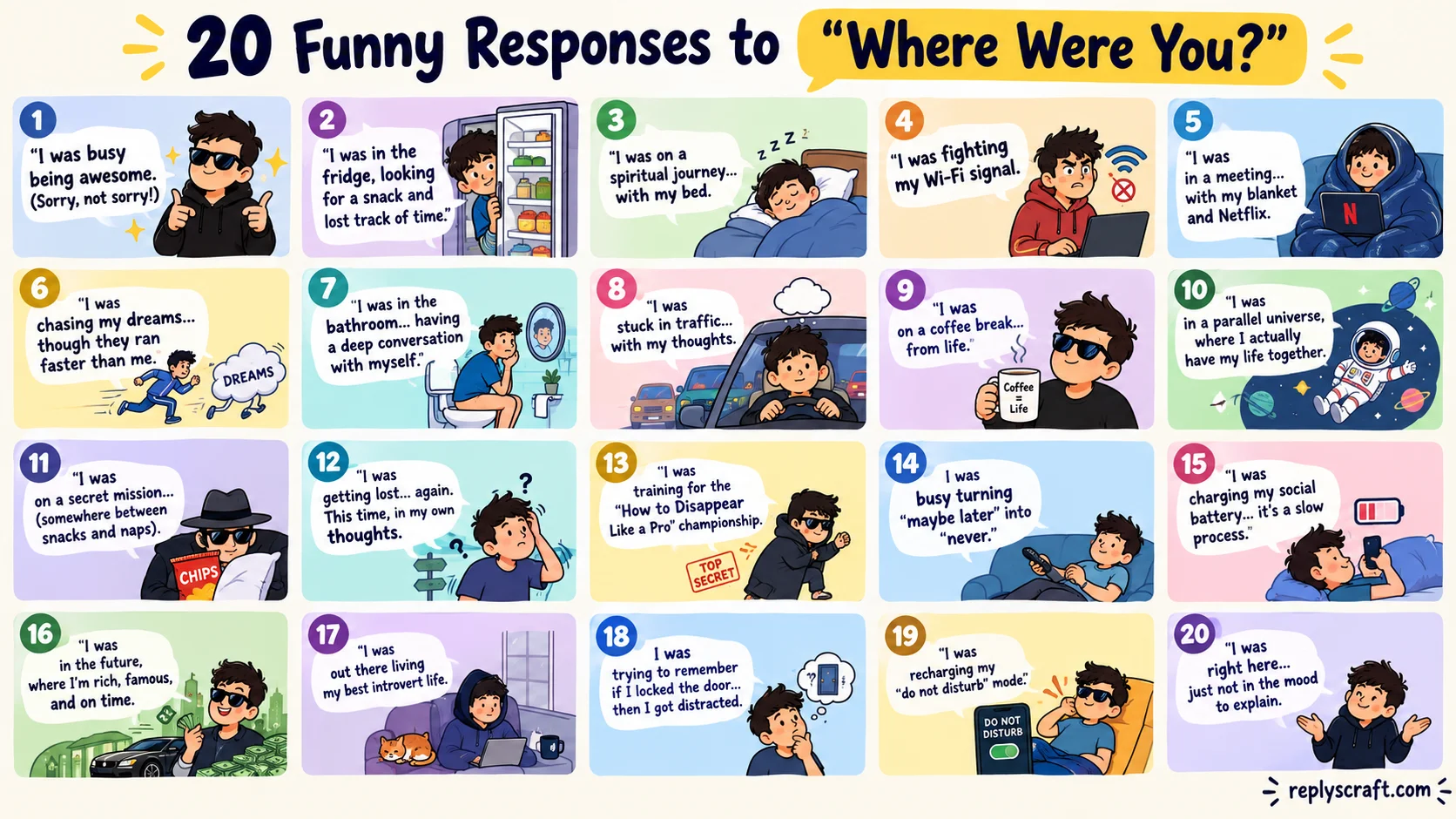

Ever wondered how to answer “Where Were You?” without sounding vague, defensive, or awkward? Responses to “Where Were You?” can make everyday conversations clearer, friendlier, and more natural and confident.
This guide explores practical replies for casual chats, business communication, and everyday situations involving scheduling, meetings, or time management. You’ll discover how context, tone, and English usage shape each response, helping you communicate naturally while maintaining clarity, confidence, and consistency across different conversations in practice.
From friendly explanations to polished answers, we’ll examine wording that suits online booking, broadcasting, calendar updates, and project management contexts. The article also considers grammar and formal writing, showing how thoughtful phrasing can prevent confusion and make your responses sound precise, professional, and approachable.
Funny One-Liners for “Where Were You?”
Short replies are perfect when you want to make someone laugh without turning the conversation into a long explanation. These work especially well in texting because they are quick, unexpected, and easy to send.
The trick is to sound spontaneous rather than overly rehearsed. Pick a line that matches your personality, and don’t worry about making the joke too complicated.
Meaning
These replies jokingly avoid giving a serious location while keeping the conversation light.
Tone
Funny, casual, playful.
Examples
Friend: Where were you?
You: Somewhere between “I’ll be there in five minutes” and “maybe tomorrow.”
Friend: Seriously, where were you?
You: On a top-secret mission. I can’t discuss it.
Best Use
Texting, friends, siblings, and casual conversations.
Clever Responses When You Want to Sound Witty
A clever comeback gives you a chance to answer the question while adding a little personality. Instead of simply saying where you were, you can twist the wording into something unexpected.
These responses are especially useful when the other person is joking with you first. Keep the delivery relaxed so the humor doesn’t sound defensive.
Meaning
The response turns an ordinary question into a playful word game.
Tone
Witty, confident, humorous.
Examples
Friend: Where were you all day?
You: Physically? Somewhere. Mentally? Still loading.
Friend: Where were you?
You: In a place where nobody was asking me where I was.
Best Use
Friends, group chats, and casual online conversations.
Playful Replies for a Friend
Friends usually give you more freedom to be ridiculous. If someone notices that you’ve disappeared from the group chat or haven’t answered their messages, a deliberately silly explanation can be funnier than a real excuse.
Don’t use a joke that makes your friend think something serious happened. The goal is to create a laugh, not unnecessary confusion.
Meaning
You acknowledge that you disappeared but give a deliberately exaggerated explanation.
Tone
Friendly, silly, playful.
Examples
Friend: Bro, where were you?
You: I was busy avoiding responsibilities. You caught me.
Friend: We were looking for you!
You: I was right here, just emotionally unavailable to the group chat.
Best Use
Close friends, siblings, and informal group chats.
Funny Text Responses to “Where Were You?”
Texting gives you room to be creative because you don’t have to answer immediately. A funny message can be especially effective when someone sends a simple “Where were you?” after you’ve been offline.
Keep the response short enough that it still feels like a natural text. A one-line joke often works better than an elaborate story.
Meaning
These answers make an ordinary text exchange more entertaining.
Tone
Casual, funny, conversational.
Examples
Them: Where were you?
You: Lost in thought. Unfortunately, there was no exit.
Them: Where did you disappear?
You: I went offline for character development.
Best Use
WhatsApp, Messenger, Instagram DMs, and casual texting.
Sarcastic Comebacks for Close Friends
Sarcasm can be hilarious when both people understand each other’s humor. It can also sound rude if the relationship isn’t that comfortable, especially through text where facial expressions and voice tone are missing.
Use these when the person asking already has a playful relationship with you.
Meaning
You jokingly act as though their question is unnecessarily serious.
Tone
Sarcastic, confident, playful.
Examples
Friend: Where were you for three hours?
You: I’m sorry. I didn’t realize I needed to submit a location report.
Friend: Where have you been?
You: Apparently somewhere without your permission.
Best Use
Close friends and people who regularly joke sarcastically.
Watch the tone: Avoid these with your boss, a new acquaintance, or someone who may genuinely be worried about you.
Cute Responses to “Where Were You?”
Sometimes you don’t want to sound sarcastic—you just want to be funny and harmless. Cute responses work well when the conversation is relaxed and you want to keep the other person smiling.
They are particularly useful when someone asks because they’ve noticed you haven’t been around.
Meaning
The answer uses harmless exaggeration instead of a sharp comeback.
Tone
Cute, friendly, lighthearted.
Examples
Them: Where were you?
You: Just taking a small vacation from reality.
Them: You disappeared!
You: I needed a little recharge before returning to civilization.
Best Use
Friends, casual conversations, and friendly texting.
Funny Responses When You Were Actually Busy
If you genuinely were busy, you don’t have to invent a complicated excuse. You can tell the truth while making the answer entertaining.
This approach is useful because it answers the question honestly without making the conversation feel overly serious.
Meaning
You explain that you were occupied while adding humor to the explanation.
Tone
Funny, honest, casual.
Examples
Friend: Where were you?
You: Fighting my to-do list. It won.
Friend: Why didn’t you reply?
You: I was busy pretending I had my life together.
Best Use
Friends, coworkers you know well, and casual messages.
Funny Replies When You Were Sleeping
If your disappearance was caused by a nap or an unexpectedly long sleep, you already have plenty of material for a joke.
These responses work because most people can relate to accidentally sleeping longer than planned.
Meaning
You turn your sleep into an exaggerated adventure.
Tone
Funny, relaxed, relatable.
Examples
Friend: Where were you?
You: On a very important meeting with my pillow.
Friend: Why were you gone so long?
You: I accidentally entered sleep mode and forgot the password.
Best Use
Friends, family, and casual texting.
Dramatic Answers for Extra Humor
Sometimes the funniest response is deliberately overdramatic. Instead of treating “Where were you?” like a normal question, respond as if you’ve just returned from an epic journey.
This style works best when everyone knows you’re joking.
Meaning
You exaggerate a normal situation into a dramatic story.
Tone
Dramatic, ridiculous, playful.
Examples
Friend: Where were you?
You: I have returned from places no Wi-Fi signal has ever reached.
Friend: Where did you disappear to?
You: A dark and mysterious place called Monday morning.
Best Use
Friends, social media replies, and group chats.
Funny Responses When Someone Is Checking Up on You
If someone asks “Where were you?” because they’ve noticed your absence, a joke can acknowledge their concern without making the situation awkward.
Here, it’s better to keep the humor warm rather than sarcastic.
Meaning
You recognize their concern while keeping the answer relaxed.
Tone
Friendly, reassuring, humorous.
Examples
Them: Where were you? I was wondering about you.
You: Nowhere dangerous—just temporarily kidnapped by my responsibilities.
Them: You disappeared on us.
You: I’m back. The mission was boring, but I survived.
Best Use
Friends, family, or people who genuinely care about you.
Confident Comebacks When Someone Is Teasing You
If “Where were you?” is really a teasing question, you can answer with confidence instead of trying to explain yourself.
The humor comes from acting completely unbothered.
Meaning
You play along with the teasing instead of becoming defensive.
Tone
Confident, witty, playful.
Examples
Friend: Where were you hiding?
You: Somewhere fabulous. You wouldn’t have survived.
Friend: Finally decided to show up?
You: I like making an entrance.
Best Use
Friends, playful arguments, and casual group conversations.
Flirty Responses to “Where Were You?”
If the question comes from someone you’re interested in, you can turn it into a playful opening. Flirty responses should feel natural rather than overly intense.
A subtle answer is usually safer than immediately making the conversation romantic, especially if you’re unsure about the other person’s interest.
Meaning
You use the question as an opportunity for light romantic teasing.
Tone
Flirty, playful, confident.
Examples
Them: Where were you? You disappeared.
You: Probably somewhere wondering when you’d notice.
Them: Where have you been?
You: Around. I was waiting for a good reason to come back.
Best Use
Dating, flirting, and conversations with someone who already enjoys playful banter.
Funny Responses for Someone You Like
When you like someone but don’t want to make your reply too obviously flirty, use a softer form of humor.
This keeps the conversation open without putting too much pressure on the other person.
Meaning
The response shows personality while leaving room for the conversation to become more playful.
Tone
Cute, subtle, slightly flirty.
Examples
Them: Where were you?
You: Just giving you enough time to miss me.
Them: Where did you disappear?
You: I thought I’d make my comeback more interesting.
Best Use
Dating apps, DMs, texting, and early-stage flirting.
Funny Replies When You Don’t Want to Say Where You Were
Sometimes you simply don’t want to share your location. You can protect your privacy without making the conversation uncomfortable.
A humorous deflection works when the person is asking casually and you don’t need to provide details.
Meaning
You avoid answering directly while making your boundary feel light.
Tone
Playful, mysterious, confident.
Examples
Them: Where were you?
You: That’s classified information.
Them: Where did you go?
You: Somewhere that deserves a sequel, not an explanation.
Best Use
Casual conversations when you don’t want to share details.
Short Replies for “Where Were You?” on Social Media
Social media comments often need quick responses. A short, witty line is easier to read and more likely to fit naturally into a public conversation.
Don’t over-explain. The humor should be visible immediately.
Meaning
These are compact comebacks designed for quick online interactions.
Tone
Short, witty, casual.
Examples
Them: Where were you?
You: Plotting my return.
Them: Where did you disappear?
You: Buffering.
Best Use
Instagram comments, Facebook, TikTok, and quick replies.
Funny Answers When You’re Late
Being late gives you an obvious opportunity for humor, but don’t use a joke to avoid apologizing when the delay genuinely affected someone.
If the situation is harmless, a funny explanation can lighten the mood.
Meaning
You acknowledge your lateness without taking the situation too seriously.
Tone
Funny, self-aware, casual.
Examples
Friend: Where were you? We’re waiting!
You: I was following Google Maps, but apparently even technology has trust issues.
Friend: You said you’d be here early.
You: I was early in my imagination.
Best Use
Friends and casual plans where your lateness isn’t causing a serious problem.
Professional Ways to Answer “Where Were You?”
Humor isn’t always appropriate at work. If a manager or colleague asks where you were, answer clearly first. If the environment is relaxed, a small touch of humor may be fine, but don’t let the joke replace useful information.
Meaning
You give the necessary information while keeping your communication professional.
Tone
Professional, polite, lightly humorous when appropriate.
Examples
Colleague: Where were you?
You: I was handling the client call. Sorry I missed your message.
Colleague: We couldn’t find you earlier.
You: I was in the meeting room. I should have let you know before stepping away.
Best Use
Workplace conversations, especially when accountability matters.
Better choice: When you’re unsure whether humor is appropriate at work, give a straightforward answer first.
Funny Responses for Family Members
Family members often ask “Where were you?” out of curiosity or concern. A playful response can work, especially with siblings or relatives who enjoy joking around.
With parents or someone genuinely worried, reassure them before making the joke.
Meaning
You keep the family conversation light while acknowledging the question.
Tone
Warm, funny, familiar.
Examples
Sibling: Where were you?
You: Out there contributing to the mystery of the family.
Parent: Where have you been?
You: I’m home now—safe, sound, and ready for the investigation.
Best Use
Siblings and relaxed family conversations.
Mysterious Replies That Make Them Curious
If you want to keep the conversation playful, a mysterious answer can make the other person ask a follow-up question.
The key is not to make the mystery sound suspicious. Keep it obviously playful.
Meaning
You intentionally give an incomplete answer to create curiosity.
Tone
Mysterious, playful, teasing.
Examples
Them: Where were you?
You: Somewhere I probably shouldn’t have been… but that’s a story for another day.
Them: Where?
You: If I told you, I’d have to invent a better story.
Best Use
Friends, flirting, and playful conversations.
Best Responses When You Want to End the Conversation
Not every question needs a long conversation. If you want to answer lightly and move on, choose something brief.
These replies work particularly well when you’re busy or don’t feel like explaining yourself.
Meaning
You respond without opening the door to a long interrogation.
Tone
Casual, confident, light.
Examples
Them: Where were you?
You: Out and about. All good now.
Them: Where did you go?
You: Just handling a few things. Nothing exciting!
Best Use
Casual texts, acquaintances, or situations where you prefer not to give details.
How to Choose the Right Funny Response
The funniest line isn’t necessarily the best line. Your relationship with the person matters more than the joke itself.
If you’re talking to a close friend, sarcasm and exaggerated stories can work well. If you’re talking to someone you like, a subtle playful response may be more natural. At work, keep the answer professional unless the conversation is clearly informal.
A useful rule is to match their energy. If they ask casually, keep your response light. If they sound worried, reassure them first. If they’re teasing you, playful confidence can work better than a defensive explanation.
Quick tip: If you wouldn’t normally say the line out loud, don’t force yourself to send it. The best comeback should still sound like you.
FAQs:
What does “Where Were You?” mean?
“Where Were You?” usually asks about someone’s recent location or absence. The meaning depends on the situation, relationship, tone, and conversation context.
How should I respond to “Where Were You?”
You can give a simple, honest response based on the situation. For casual conversations, keep it friendly. In professional settings, provide a clear and relevant explanation.
Is “Where Were You?” grammatically correct?
Yes, “Where Were You?” is grammatically correct. It uses the past form of “be” and asks about someone’s location or whereabouts at an earlier time.
How can I respond without sounding rude?
Use a polite and natural tone instead of giving a short or defensive answer. Adding a brief explanation can make your response feel more respectful and conversational.
Can I use funny responses to “Where Were You?”
Yes, funny responses can work well with friends or people who understand your humor. Avoid jokes in serious, professional, or sensitive situations where clarity and respect matter.
Conclusion:
Responses to “Where Were You?” can vary depending on the situation, relationship, and tone. Choosing the right words helps you communicate clearly, naturally, and confidently.
Whether you need a funny, friendly, casual, or professional response, understanding the conversation context makes your answer more effective. Use clear language, appropriate tone, and honest explanations to keep every conversation comfortable and natural.



